Society for Business Ethics 2025, Copenhagen, Denmark
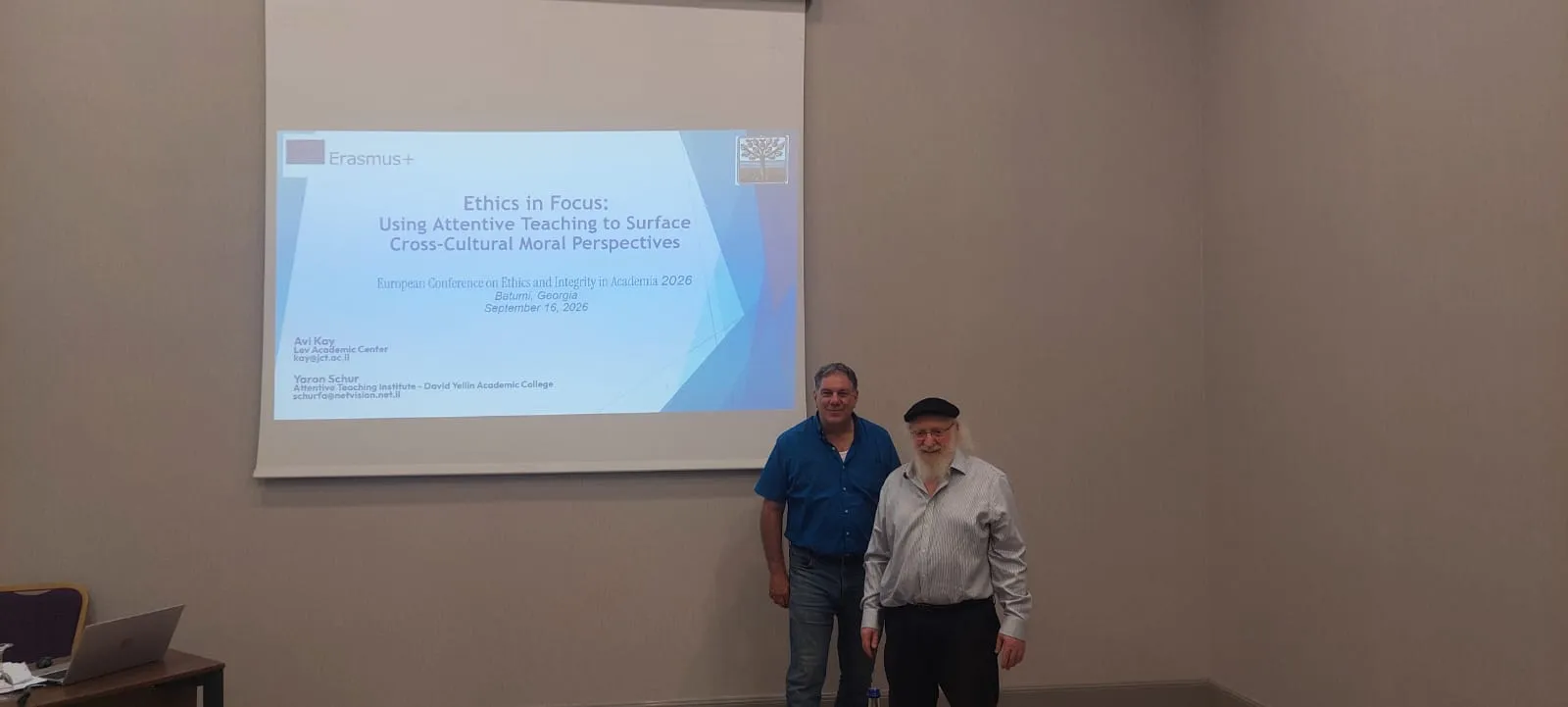
In July 2025 the project was presented at the annual meeting of the Society for Business Ethics in Copenhagen, in a session led by Avi Kay of the Lev Academic Center and Yaron Schur of the Attentive Teaching Institute at the David Yellin Academic College.
Rather than describing the method, the session ran it. Participants were asked to present their own ideas about Business Ethics, Corporate Social Responsibility or Sustainable Development through a visual representation: a drawing, an image found online, or an image generated with AI. Each participant then explained what they had made.
What followed was a group discussion in which participants presented their visual outputs and the other participants and the workshop leaders offered comments and questions. The purpose was to clarify each participant’s attitudes and expectations, and to surface the commonalities and the differences among them.
Why visual representation
This is the core of what the project calls mediated interaction. Asking someone to define business ethics in words tends to produce the definition they believe is expected of them. Asking them to draw it, and then to explain the drawing, produces something closer to what they actually think.
The approach rests on a set of principles that the project calls the Attentive Teaching pyramid: the student’s inner world at the centre; emotional and cognitive mediation alongside attentive dialogue; tolerance for uncertainty, and mistakes treated as milestones rather than failures; active use of imagination and of drawings and visual representations; and learning understood as a journey.
In the classroom, this translates into a small number of working commitments. The voice of each participant matters. Visual representation is introduced as a language in its own right. Each participant is assumed to hold their own unique conceptualisations. The mediator and the participants are jointly involved in a discourse that creates the classroom’s shared understanding, participants connect what they understand to their own worlds, and the process of conceptual change is made visible as it happens.